Embodied data
from real hardware.
We operate the robots ourselves — teleoperation on dual-arm and humanoid platforms, tactile-glove motion capture, and egocentric vision — and deliver it synchronized, segmented, and quality-gated.
Three principles.
Real hardware, real signal
Every episode is collected on physical platforms we operate — synchronized multi-camera video, depth, end-effector and joint states, and tactile signal captured together, in time. Ground truth is measured from the hardware, never estimated after the fact, so the physics in the data is the physics of the world.
Operators and QC in the loop
Trained teleoperators execute against task protocols, and every episode passes multi-stage human and automated review before it counts. Acceptance is a gate, not a spot check — episodes that drift from protocol, drop sync, or miss the task are rejected, and billing is on qualified data only.
Coverage across the pyramid
Embodied capability is built in layers — from atomic manipulation skills to long-horizon household, industrial and outdoor tasks. We design collection as a pyramid, not a pile: skill distributions are planned, tracked and reported, so diversity is a property of the dataset rather than an accident of collection.
How an episode is made.
Synchronized by construction
Multi-camera video, depth, pose and tactile streams are captured on a common clock, against a written task protocol — so alignment is a property of the rig, not a post-processing step.
Labels down to the frame
Episodes are segmented into skill spans at frame granularity — reach, grasp, place, recover — so the data supports skill-level training and evaluation, not just end-to-end imitation.
QC before it counts
Multi-stage human and automated review checks protocol adherence, sync integrity and label quality against contractual acceptance targets. What fails is re-collected, not shipped.
Labels you can verify.
Episode → subtask → phase
Each recording is segmented into per-object episodes, pick / place subtasks, and motion phases — approach, grasp, lift, transport, release, retract. Phase boundaries are derived from the high-rate gripper joint signal, so every cut in the label sits on a measurable event, not an annotator's guess.
Boxes, cells and occlusion
Keyframes carry bounding boxes for every object and container in the head camera, placement is scored against the task's target cell, and per-segment occlusion is measured — so language, pixels and outcome stay attached to each other throughout the episode.
Success is confirmed, not assumed
Each subtask ships an evidence checklist — gripper closed, object held with stable width, placed in the target cell, gripper retracted — and the verdict is recorded with the frame at which the last piece of evidence lands. Motion quality metrics (speed, path length, smoothness, pauses) ride along per phase.
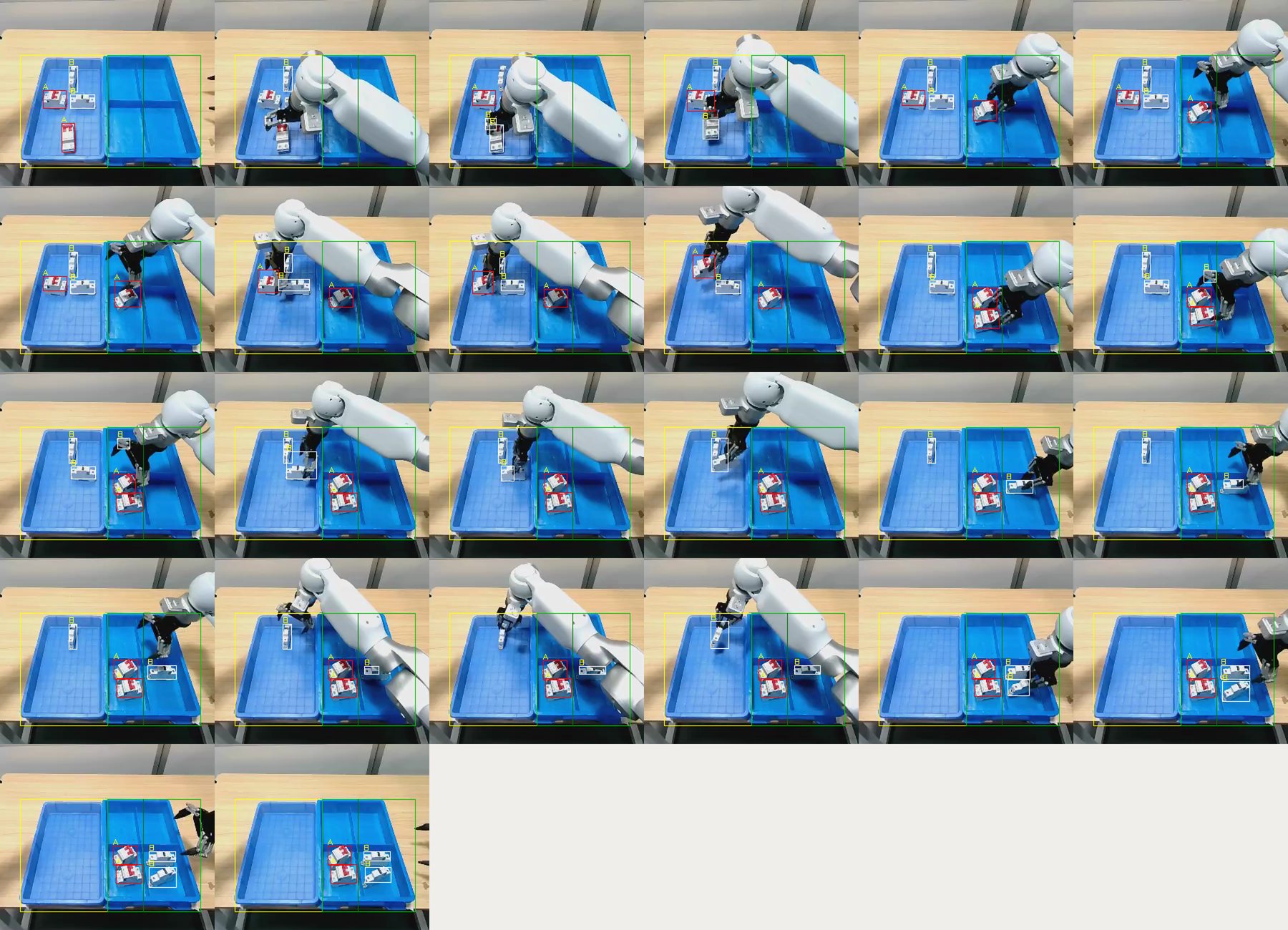
A live viewer for this episode — synced video, phase timeline and per-frame label inspector — is part of sample access. Request samples.
Collection programs.
Teleoperation
Task-directed manipulation on wheeled dual-arm and humanoid platforms — household, kitchen and industrial scenarios executed by trained operators against written protocols.
Tactile & motion capture
Glove-based capture of human hands doing fine-grained work — contact, force and pose signal for the dexterity layer that vision alone can't teach.
Egocentric vision
First-person video of humans performing everyday and expert tasks — the perception-and-intent layer of the pyramid, aligned with the same skill taxonomy as the robot data.
Field & outdoor operation
Navigation and delivery in unstructured outdoor environments — weather, terrain, pedestrians — where the long tail of the physical world actually lives.
From overview to catalog.
This page — platforms, methodology, and what differentiates the collection.
Representative episodes with full modality streams and labels, on request.
A scoped collection run against your protocols and acceptance criteria.
The full browsable robotics catalog — episode inventories, scale and specs — customer access.
The full catalog — episode inventories, scale and specs — is available to customers. Request access and we'll respond within one business day.
See the data behind this page.
We'll share representative episodes, collection protocols, and scoping for custom collection programs.