Tidel.ai
Capability · Multimodality

Multimodal data,
graded on the render.

Data for models that read what they see and build what they're asked — every answer checked against the page, every build against the render.

long-document vision·3D creation·interactive web 3D·browser 3D games

Swipe sideways to explore. Tap a view to change the shading.

How we approach multimodal data

Three principles.

philosophy before catalog
01

Graded where it renders

Answers are checked against the page they came from, builds against the frame they produce. The reward follows what a person would actually see — never a text proxy for it.

02

Verifiers that survive the optimizer

We attack every grader before it ships — blank canvases, stub scenes, tampered judges. Anything that lets a non-solution score gets rebuilt.

03

Expert taste, made measurable

Domain experts write the rubrics and review the outputs criterion by criterion, each tied to evidence you can point at in the frame or on the page.

What we build

Featured datasets.

a selection · more in the catalog
Dataset 01 · hard-vision QA

Long-document vision

Professional questions over long, real documents — reports, handbooks, standards, scanned test records — where the answer sits in a chart, a drawing, a handwritten table or a change between editions. Every answer is graded against the pages it came from.

44–276-page documentscharts · plats · scanscross-edition checkspage-cited rubrics
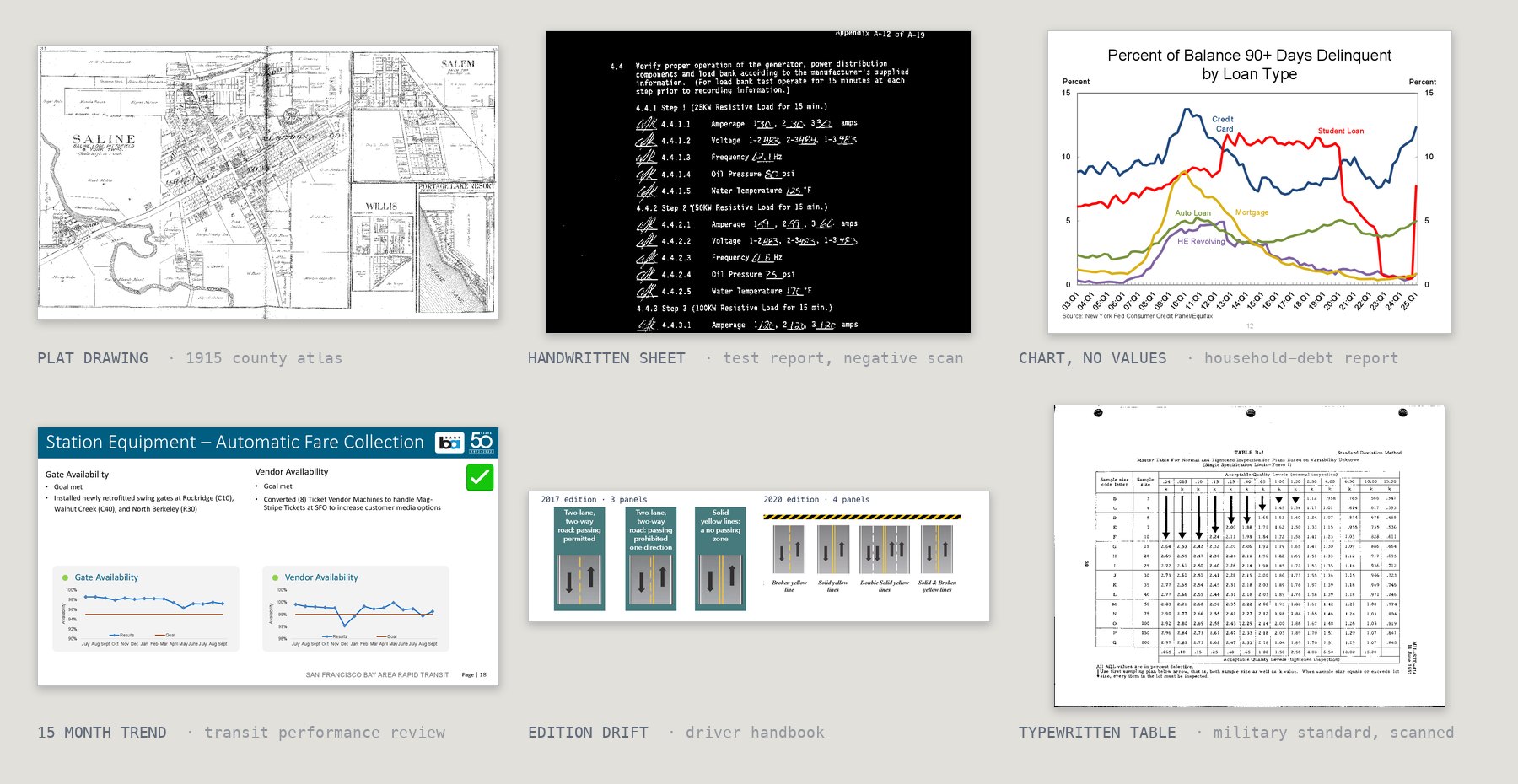
where the answers live · six evidence pages
Six evidence pages: a 1915 plat drawing, a handwritten generator test sheet, a household-debt chart without printed values, a transit availability trend chart, the same driver-handbook illustration in its 2017 and 2020 editions, and a scanned typewritten sampling table
Evidence behind real items: a 1915 plat drawing, a handwritten test sheet, charts that never print their values, and an illustration that changed between handbook editions.
Dataset 02 · Blender asset construction

Tutorial to 3D

The agent follows a real illustrated tutorial and delivers the still-editable Blender project, not a picture of one. We reopen it and measure geometry, materials and animation against a reference build the agent never sees.

procedural materialsglass & refractionsimulation & animationhidden reference
Blender · 3D turntable15 seconds · 1080p
A 15-second turntable view of a celadon teapot, showing its silhouette, crackle glaze, floral detailing and metallic accents.
Dataset 03 · editable models + web

Blender to Web3D

From a written brief and visual references, the agent models an object or scene in Blender and ships it as a working web experience — exploded assemblies, animated mechanisms, guided tours, first-person walkthroughs.

.blend + build scriptsruntime assetsrunnable web producttask-specific rubrics
Lynxsdesign · architectural interiorOpen artwork · CC BY
Architectural interior by Lynxsdesign: gray sofas, sculptural chairs and a glass-sided staircase in a sunlit double-height living room
Openly licensed visual reference: the Blender 4.1 splash scene by Lynxsdesign, rendered from the editable Blender project. This image illustrates scene, material and lighting quality. Artwork source & CC BY credit.
Dataset 04 · interactive 3D creation

Web3D with Three.js

Browser-native 3D built in code — procedural geometry, materials, lighting, camera controls and interaction — delivered as an editable, runnable Three.js project with multi-view captures.

procedural geometrymaterials & lightingcamera & interactionmulti-view captures
Poseidon · open-source ocean showcaseThree.js / WebGPU
Sunset reflected across the waves of Poseidon's real-time ocean simulation A WORLD WRITTEN IN WAVESPoseidonExplore the ocean
Real-time waves, foam and sunlight, rendered with Three.js. An adapted open-source demonstration by owenyuwono; shown as a visual reference, not a dataset delivery. Credits & licenses.
Dataset 05 · browser 3D games

Browser 3D games

A complete, playable WebGL / WebGPU game from a bare Vite starter — world, controls, objectives, HUD. Behavior is graded from scripted play sessions, not from the code alone.

WebGL / WebGPUbare Vite starterscripted play sessionsHarbor tasks
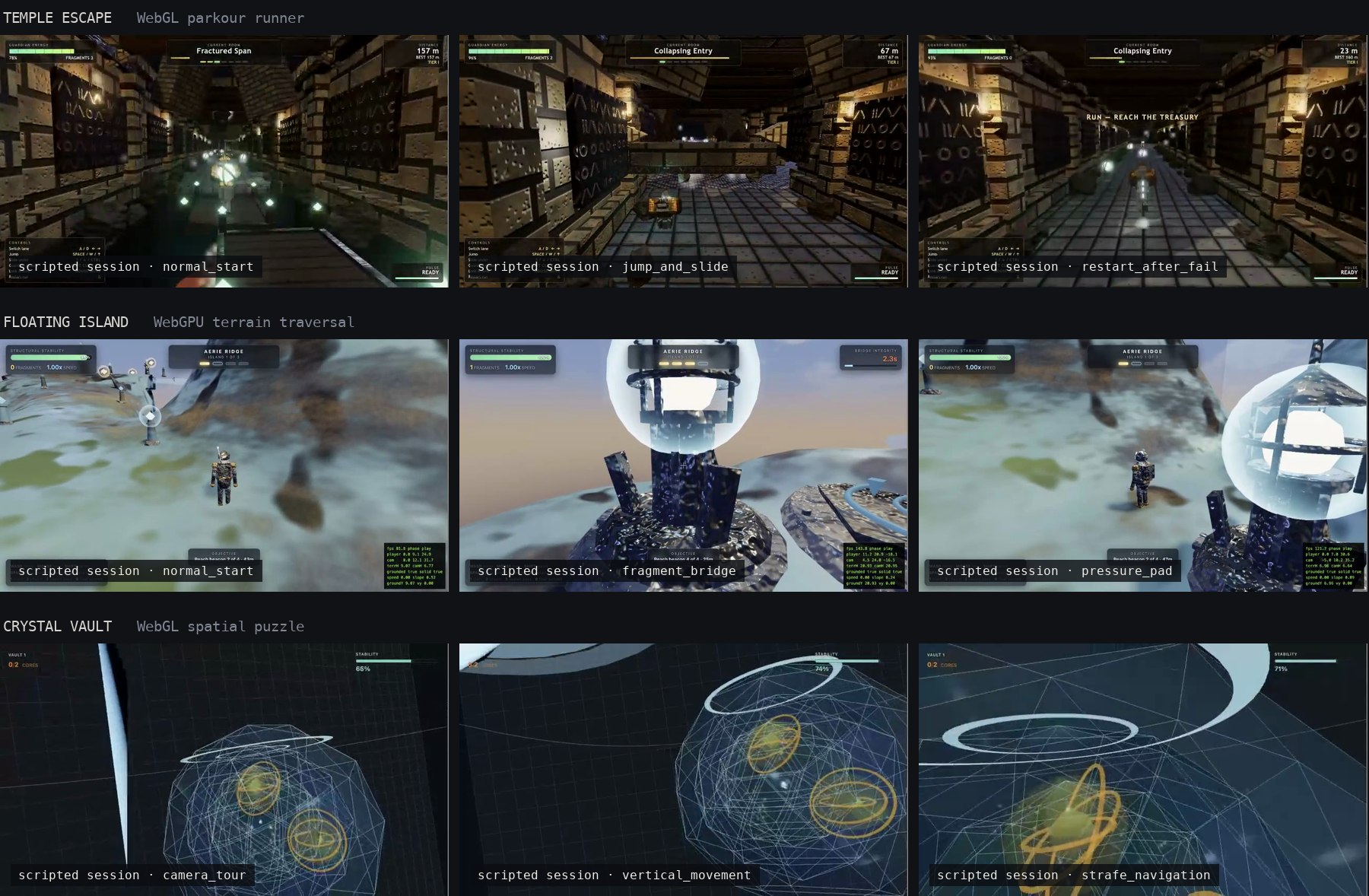
three games · frames from scripted play sessions
Frames from scripted play sessions of three browser games: a temple-escape runner in collapsing stone corridors, a third-person traversal game on a floating island, and a wireframe crystal-vault puzzle
Every frame comes from a scripted session the verifier replays in a real browser — start, jump, fail, restart — so behavior is judged on what the game actually does.

These are a few featured datasets — the full catalog covers more task families, with scale and measured difficulty for each. Request access.

Formats

Built for the training loop.

four formats · same tasks

The same tasks come in four formats — pick the one that matches how you train.

SFT Step-by-step trajectories

A full record of each task being solved: every action, every screenshot checked, every fix. It shows a model how the work actually gets done.

RL Ready-to-run environments

Each task in a container with its tools and an automatic grader. The model tries, gets a score and learns from it. Graders are tested against cheating first.

Reward models Expert ratings

Experts score outputs against a checklist and pick the better of two, noting what's wrong. For training models that judge visual work.

Evals Held-out test sets

Tasks never used for training, each with a pass rate measured on today's top models — so you can see where yours stands.

Going deeper

From overview to catalog.

detail is disclosed progressively — by design
Layer 01 Overview

This page — datasets, principles, and how outputs are graded.

Layer 02 Samples

Representative task packages — briefs, reference files, renders, verifiers and rubrics — on request.

Layer 03 Pilot

A scoped batch against your runtimes, formats and acceptance criteria, with measured pass rates.

Layer 04 Full catalog

Task inventories, scale and measured difficulty — customer access.

The full catalog — task inventories, runtimes and measured difficulty — is shared under NDA. Request access and we'll respond within one business day.

See the data behind this page.

We'll share representative task packages — reference files, renders, verifiers and rubrics — and scoping for custom programs.